The 5 Mother Sauces: A Beginner's Guide to Culinary Foundations
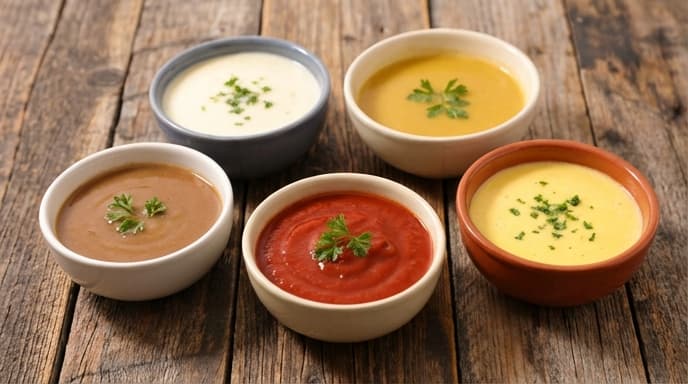
What if you could learn just five simple recipes that form the foundation for hundreds of others? That's the power of the French 'mother sauces,' the building blocks that every great chef masters first. Codified by Auguste Escoffier in the 19th century, these five sauces are the starting points from which countless 'small sauces' (or secondary sauces) are derived. Master them, and you'll unlock a new level of confidence and creativity in the kitchen.
The Secret Starts with a Roux
Three of the five mother sauces start with a roux: a simple mixture of equal parts flour and fat (usually butter) cooked together. The roux serves to thicken the sauce. The length of time you cook the roux determines its color and flavor, from a white roux (cooked briefly) to a blond or brown roux (cooked longer for a nuttier, deeper flavor).
Breaking Down the 5 Mother Sauces
Each mother sauce is defined by its liquid and its thickening agent.
1. Béchamel
Liquid: Milk
Thickener: White Roux
This is arguably the simplest mother sauce. It's a creamy, rich sauce made by whisking hot milk into a white roux. It's the base for classic dishes like lasagna, mac and cheese (as a Mornay sauce, with cheese added), and scalloped potatoes.
2. Velouté
Liquid: White Stock (veal, chicken, or fish)
Thickener: Blond Roux
Velouté means 'velvety' in French, and that's the perfect description. It's similar to Béchamel but uses a light-colored stock instead of milk, giving it a more savory, nuanced flavor. It's the starting point for gravy, cream of mushroom soup, and various white wine sauces.
3. Espagnole
Liquid: Brown Stock (usually veal)
Thickener: Brown Roux
Espagnole is a rich, dark brown sauce with a deep flavor. It's more complex, often including mirepoix (a mix of sautéed carrots, onions, and celery), tomato purée, and herbs. It is the foundation for demi-glace, Bordelaise sauce, and mushroom sauces.
4. Tomate
Liquid: Tomatoes
Thickener: Optional (can be thickened by reduction or a roux)
While we all know tomato sauce, the classic French version is a bit more refined. It often starts with salt pork and is simmered with stock and vegetables to create a richer, deeper flavor than a simple marinara. It's the base for countless pasta sauces and dishes.
5. Hollandaise
Liquid: Butter
Thickener: Egg Yolk (Emulsification)
Hollandaise is the only mother sauce that doesn't rely on a roux. It's an emulsion, created by slowly whisking melted butter into egg yolks. It's a tangy, rich sauce famous for its role in Eggs Benedict. With the addition of tarragon, it becomes Béarnaise sauce, perfect for steak.
Frequently Asked Questions (FAQ)
What is a 'small sauce'?
A small sauce, or secondary sauce, is created by adding other ingredients to a mother sauce. For example, adding cheese to Béchamel creates a Mornay sauce. Adding mushrooms and shallots to Espagnole creates a Chasseur sauce.
Why are they called 'mother' sauces?
Because they are the 'heads' of their own unique families of sauces. From these five, countless variations can be 'born'.
Is mayonnaise a mother sauce?
While mayonnaise is also a classic emulsion like Hollandaise, it is typically considered a 'cold mother sauce' and is sometimes categorized separately from the five main 'hot' sauces.
Key Takeaways
- The five mother sauces are Béchamel, Velouté, Espagnole, Tomate, and Hollandaise.
- They are the foundational building blocks of classical Western cooking.
- Three are thickened with a roux (flour and fat); one is an emulsion (Hollandaise).
- By learning these five, you can create hundreds of 'small sauces' by adding other ingredients.
- Mastering them is a key step to becoming a more versatile and creative cook.
Suggested Internal Links
- The Maillard Reaction: Unlocking Maximum Flavor in Your Cooking
- Beyond the Pinch: A Practical Guide to Mastering Salt in Your Cooking
- The Science of Brining: Your Secret Weapon for Juicier, More Flavorful Meat
Sources for Verification
- Classic French culinary texts and professional cooking resources.
- General knowledge of culinary history.